


Episode Description
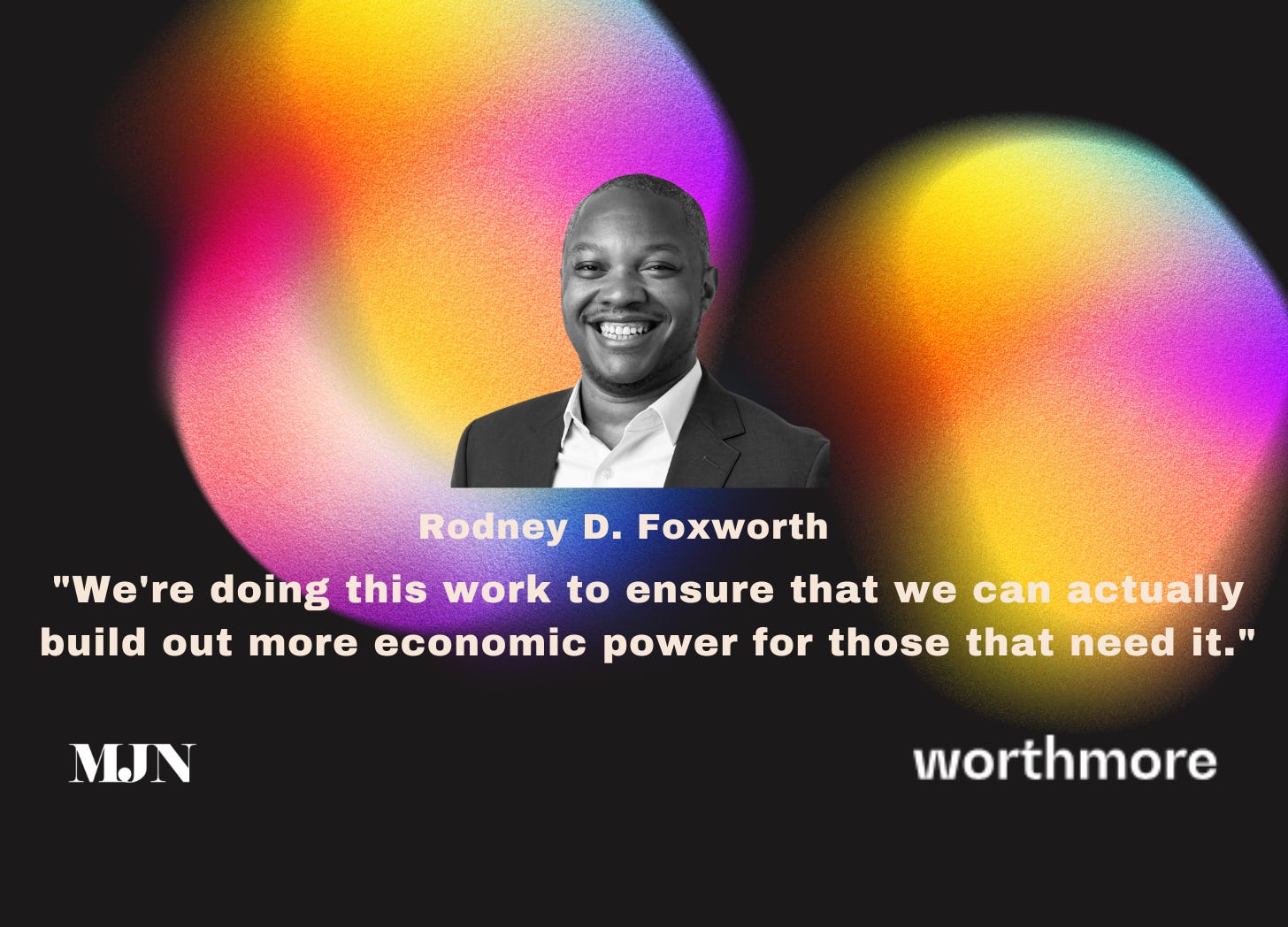
Mission-driven entrepreneur, Co-Founder and CEO of Worthmore Inc., Rodney Foxworth has always interrogated paradigms and the status quo, even as a young boy growing up in Baltimore. Rodney shares his story - from police encounters as a young journalist, to his career journey focused on creating new pathways that deliver economic justice.
Later, he and Make Justice Normal co-founder and host Monique Aiken dive into a deep conversation about the importance of shifting power, and investment capital, into the hands of communities with reparative economics and how wealth holders can, indeed, be part of the solution.
If you'd like to learn more about Rodney and his new venture, visit www.rodneyfoxworth.com and worthmore.co.
Available on Apple Podcasts, Spotify Podcasts, Stitcher, Pandora and Amazon Music
The main Into the Record RSS can be found here.
Explore More
Rodney Foxworth: www.rodneyfoxworth.com
Worthmore: www.worthmore.co
Episode Transcript
RODNEY FOXWORTH, GUEST:
There were checks that were written during that time, but there were a lot of promises of checks being written that never happened. So there's actually a lot of data and reporting that speaks to how a lot of corporations and others made promises that they never even wrote those checks. Your question about how do we keep the commitment to racial justice ongoing is really a recognition that we have to accept that those who hold the most wealth can't continue to hold that wealth forever.
(THEME MUSIC IN)
MONIQUE AIKEN, HOST:
What would the world be like if justice were normal? What if wealth and power were not basically synonyms and did not always go hand in hand? I'm Monique Aiken, your guide for Into the Record, a podcast from the Make Justice Normal collective, on a mission to foster just relationships and collective action among people working to make justice normal. In each episode, we'll hear from change makers who interrogate history and the status quo. They're forging a new imagination of what's possible as we create new systems where justice is the default and injustice, the stuff of history books. Our guest today is Rodney Foxworth, co-founder of Worthmore.
(THEME MUSIC OUT)
RODNEY FOXWORTH:
I think of myself as a younger kid, having that curiosity, really having little to no understanding about the outside world and what it meant for me as a young Black boy. I think I'd be really curious and would like to have an understanding of what my life story was, to really connect it to all the things that my mom was really preparing me for, about how I would need to handle myself if law enforcement was in a situation. I didn't really know what that meant when I was a preteen or teenager, really. My mom read a lot to me. I was fortunate to, coming up in the Baltimore City public schools, to be educated by a number of Black women teachers. I had a teacher who is now the principal of the high school I went to, my ninth grade year. I wrote an essay, I can't even remember what the essay was, but what I remember was she said to me that she could see me having a career as a writer, which was really powerful at that stage in my life, to have someone reflect back to me that I had some kind of capacity or talent that would be treasured in the world.
When I was a teenager, I had a tough time of going through adolescent stage where my mom had asked me, instead of going directly home from school to actually meet her at her work and then we'd go home together. So that changed my entire transportation situation, which seems like a really small thing, but it was material in the sense of I had these experiences where I was being picked on. And one day, I was waiting for my mom outside of her office. Her office was directly across from the courtroom where a lot of individuals were being sent to see the judge. And something I recognized at 12, almost every day I went to situate myself in front of my mother's office, the line of young Black men, it was mostly Black men. I'm 39 years old. I would say that there was a line of Black men between 16 to 45, a long line of Black men waiting to have their time with the judge.
That impacted me because as I said, I was quite down on myself at that time, and I think, I don't know if my mom was intentional about this, but one of the reasons she wanted, it was one, she had safety for me in mind, for me to commute with her heading home. But I think there was this other thing because it was this really reflective thing for me to be able to see this line of Black men being sent to the criminal justice system. It gave me a perspective around the privileges that I had and how I needed to think about it. Again, I didn't have that language at that time, but from a visceral perspective, I really just had a clarity for me at that moment. Another time that really animates me was I had to, like a lot of folks who go to college, I worked through the back half of my college years.
I was working almost full-time and I was freelancing for this publication in Baltimore that no longer exists. I had the situation where I was on a lunch break and I was coming back to the office. I actually got robbed at gunpoint. Coming up in Baltimore, these things happen. It's like, all right, this is my day today, and you get a sense for how to handle these sorts of scenarios. So actually the traumatic experience wasn't actually being robbed at gunpoint. The traumatic experience was coming back to the office, and I had no thought on calling the police. There's no reason for that. The editor, my editor at the time, I told them the story and they're like, "Rodney, you have got to call the police. What are you talking about? Call the police."
So I call the police. They come to meet me. They take me to the scene of the crime, and they're asking me things like, "Are you sure this wasn't like a drug deal gone wrong? You sure you didn't know this person and there was some incident between you?" It was exactly why I didn't want to call the police to begin with. I just thought it was going to be a waste of my time or worse than a waste of my time, it was going to actually be a traumatic experience. So I went back to the office and I explained to my editor what happened, and they're like, "Do they not know that you work here and that you're a journalist?" Et cetera, et cetera. And I said to them, "They don't care. They just see a young Black guy. It doesn't matter that I'm a journalist with Byline."
MONIQUE AIKEN:
You wrote about some of new initiatives and activations at Common Future that you were leading when you were CEO at that time. You wrote in a piece in Medium that justice demands more of us. As you personally updated all kinds of processes and relied on different kinds of stakeholders in order to shift capital, shift power in your own institution at the edge of your own fingertips, and you were out front on that. And so what has been the direct impact on your life and your leadership style in the years since making that statement? And what did you learn?
RODNEY FOXWORTH:
I think I'm still learning, Monique, honestly, when it comes to this. When I made the statement that you referenced, but also the work that we were doing at Common Future, at the time that I made the statement and we started putting things into play, it actually wasn't a difficult thing to do at all. Two years prior when I was really just getting started at Common Future, I had written a piece called Wealth Inequality in the Fallacies of Impact Investing. And I wrote that I think in February 2018, or at least that's when it was published. When George Floyd is murdered in 2020, it's interesting to reflect back to some individuals and institutions that responded to my Black Rage piece and my Wealth and Equality piece saying, "Wow, this is making us very uncomfortable. I don't know if I can be associated with this," but you go to May of 2020 after the murder of George Floyd, and they're singing a different tune.
And so in some ways, the actions that we were taking in 2020 was actually quite easy to do, Monique, because for some... I don't know if people were really legitimately committed to this, but they felt that they needed to at least have affirming words to me in our actions and prior instances in which there was a bit of risk in putting out those types of statements and actions. Because as I said, there were folks who literally decided not to associate themselves with Common Future at that time because of that kind of critique. Now, two years later, they were on board. And so anyway, I say that just to point out that that actually that moment was actually not a very hard moment for me to make that stance and to make those actions, quite frankly was harder in years past. And I'd also say that there's probably things happening now, Monique, that's even more challenging because, and as you've experienced, you and I, we've been around the block on this many times where folks care a lot about racial injustice for 18 months and then it dissipates. And so even saying things now is probably more challenging than it was three years ago. It's a really fascinating thing, and to make sense of it is really difficult.
MONIQUE AIKEN:
I'm curious about what it might take to actually shore up the ability for all of us to make enduring change.
RODNEY FOXWORTH:
There were checks that were written during that time, but there were a lot of promises of checks being written that never happened. So there's actually a lot of data and reporting that speaks to how a lot of corporations and others made promises that they never even wrote those checks. Your question about how do we keep the commitment to racial justice ongoing is really a recognition that we have to accept that those who hold the most wealth can't continue to hold that wealth forever. I try to say this to folks, okay, so you're an institution with say, a 10 billion endowment. You're mostly a white institution and you want your racial equity investments to also return 20% annualized returns back to you. How is that actually practically solving for the racial wealth gap if you're increasing your own wealth, retaining and growing that wealth, maybe growing the wealth, potentially growing the wealth of Black communities?
And so it's an interesting dynamic where I don't think that we really have come to terms with the fact that we're going to make sure that we prioritize the return of investment to the low wealth, the working class participants in this investment before you as a high net worth individual or institution gets your return. It's typically the folks with the most money get the most money in return. And so I think that's just something we have to recognize when it comes to this commitment to racial justice is that, no, we actually have to give up a little bit for us to all be whole.
MONIQUE AIKEN:
What sparked your entrepreneurial spirit? What is the driver behind some of why you've been a founder and a creator and a maker in so many ways?
RODNEY FOXWORTH:
My sense for entrepreneurship, honestly, it was more a response to needing to make money. So I, like most people, I worked through college for the most part, and I needed something that was quite flexible. I had mentioned that I had this teacher who in high school told me that they thought I could be a professional writer one day, and one of the things that I was able to do is actually I started this career in journalism, and it was entrepreneurial in the sense that I was freelancing, and it gave me an opportunity to really explore topics that were really important to me, particularly around race and politics, education, the state of the economy in Baltimore particularly, and how that impacted Black communities specifically. And so I was actually able to take that and started doing things in marketing and business development. I had this particular skill for communication, and it really just came from there, honestly. It was how can I be most agile, go to school full-time, be able to support myself and not be wedded to a traditional nine to five structure?
MONIQUE AIKEN:
And so you talked about agility and wanting to interrogate so many different questions through the journalism path, but in that, did you come to a clear articulation of your purpose, and how did you come to find out what it was?
RODNEY FOXWORTH:
As a journalist, one of the reasons why I made the pivot from journalism to being more active and I would say more directed in an entrepreneurial sense, was it was wonderful to observe and articulate, but I didn't feel as though... I felt like I was on the sidelines when it came to actually constructing things and creating opportunities directly. And I just had this sense that I could do something there, like I could actually be a participant. Again, I want to be really clear because journalism is such a wonderful career calling and we need more of it, quite frankly, really quality journalism that really looks into what systems are, really deconstructs those systems and really communicates in a way that people can really follow along the story and not make it so exclusive. I just felt that I wanted to be much more of a participant, so that's where I made that transition for myself.
MONIQUE AIKEN:
So journalism is one tool for interrogating the system and pushing it forward. What are some of the other tools that you like to use? You also talked about economic pathways. What are some of those, and in what ways are you driving other forms of impact around racial equity and other communities that you lift up?
RODNEY FOXWORTH:
I've really taken the path around looking at local economies and regional economies and pathways and looking at how we can structure investment capital, like financial investment capital specifically, in ways that really anyone can participate, for example, in which we have the Fearless Fund in Atlanta being sued by the same coalition of individuals that took away affirmative action in colleges and universities, being sued because they are a Black woman run and owned venture capital fund that is specifically serving the interest of Black women entrepreneurs. Last year, there was nearly 300 billion dollars of venture capital invested and only 0.4% of that capital went to Black women. And yet, Fearless Fund is being sued for allocating a small portion of venture capital specifically for Black women. The founders of Fearless Fund experienced directly themselves what it's like to be Black women who are denied an opportunity to start world changing businesses because they simply don't have the friends and family capital.
They don't have the wealth themselves all because of historic patterns and injustices, and so they created a solution for that, and now it's under attack. For me, it is that pairing of looking at something, identifying a problem, calling attention to it, but then also being able to create some kind of pathway, some kind of solution. I'll say, Monique, I try not to use the word solution often because I realize that these are massive issues that we're facing, and I look at it for myself as an individual. I'm just trying to do my part to contribute. What role can I play to contribute something so that the scoreboard over time gets better for us? For an individual, it's more empowering because you can say, "Wow, this is the action I can take." That's another thing I think about, is how do we actually look at the mindset that's required, the actions that we have to take as individuals that can be much more empowering, because these are really massive systems that we're trying to rewire, right?
MONIQUE AIKEN:
Yes. And I think as a solo entrepreneur yourself, creating your version of a solution that's at the edge of your fingertips and you've interrogated the system. You have worked on those problems through organizations and through your personal brand and the ways that you have shown up in the world speaking about speaking truth to power, writing about it, and through all of this, you've assessed many emergent economic models for your own self and for the organizations that you've worked through and with. So what are some of the patterns that you've noticed in how we do things, and how does reparative economics, a particular term that you've coined, play into this work? And can you define what reparative economics is for the people who aren't familiar?
RODNEY FOXWORTH:
One of the things that I want to make sure of is I give some attribution to our dear friend Nwamaka Agbo, who is the CEO of Kataly Foundation, and actually created the concept behind restorative economics. I want to highlight that because Nwamaka and others have been so foundational to my own thinking and framing of things, and I always just want to make sure I give back the love, because we're all in this work together. It's a collective action. So one of the things I think about when it comes to this question of reparative economics, honestly, Monique, it has been a response to things like impact investing or socially responsible investing, which are incredible tools and ways of moving towards progression. And when I think about this question of how do we restore, how do we actually rewrite past and ongoing injustices, we need to take a reparative framework.
And so for example, when I mentioned the Fearless Fund and the very small amount of capital from venture capitalists that's going into Black women entrepreneurs, a lot of entrepreneurs that are in the startup ecosystem, they start off with what is known as friends and family capital. So they go to their friends, their loved ones, to give them a helping hand to get them started. Well, we know that there's a significant wealth gap, a chasm as it pertains to Black Americans specifically in such a way that it's quite almost impossible for a Black entrepreneur to get started with friends and family capital because of all the historical injustices and the extraction that has occurred. So how are you going to get started with money from friends and family when they don't have it? And so a reparative economics framework acknowledges that, for example, a Black entrepreneur doesn't have on average the friends and family capital support that say, a white entrepreneur might have.
And so reparative economics is really saying, "We need to take a real assessment of where Black and brown communities are in the contemporary and also the historic economic system, and ensure that we're not doing things from an investment perspective that does not acknowledge that, that does not acknowledge and tries to redress the prior harms which place us Black folks at a disadvantage when it comes to the economy." To your question about patterns that I've noticed on how we do things, honestly, Monique, I was having this conversation last week with a few folks that are associated with the foundation, and they were asking questions around how do we have more racially equitable investment in philanthropy? There are so many tools, it's really about the desire and the will and creativity to get things done. And so, one of the patterns that I think we constantly fall into, we constantly rely on what has happened and what are the existing tools and frameworks, rather than figuring out at least ways to iterate on those existing models, if not create vastly different ones. The other piece of it is, so much of this work boils down to do you have the will, do you have the desire, and do you have the creativity and imagination to make it happen?
MONIQUE AIKEN:
We need to close the imagination gap in order to get to this new place that we haven't lived in collectively, that is more just. And so in your view, when we start to think about power in some of those economic models that you just talked about and the way things are done, why is it important to our understanding of today's really poly crises and the solutions, long-term though they may be, needed to address them? How can we rethink who has power, call in or out who has hoarded it, and how can we think about distributing power differently?
RODNEY FOXWORTH:
From a very textbook definition of what power is, it's one's capacity or ability to exert influence to get things done in accordance to what they want. And it's really interesting because oftentimes, we talk about exclusively financial capital as a placeholder for power, but it's social capital, it's political capital, it's reputational capital, it's the universities and schools that one attends. It's very difficult for someone, say, with only a high school education, or let's say they've had some college credits from their local community college, to really have much influence in the spaces that even you and I interact in, let's just be honest about that. And that isn't necessarily about financial power, though it could have some relevance, but even that, that's about social power, social capital that has been deemed more important than others. And one of the things that I think a lot about, Monique, and we see this in our history where people mobilize and invest in their own social and reputational capital in such ways that it defies the established order of what is justified power, what is entrenched power?
And we see it all the time in our work, right, Monique, where individuals are coming up against institutions with significantly more wealth, significantly more political capital, and being able to mobilize the existing social capital that they have with say the neighbors in their community, members of their church. They can activate in certain ways that actually pushes back against the entrenched power. You and I have talked about this often about how do you make sure that you construct shared power across different institutions? And when I say institutions, I'm not talking about necessarily 501C3s or the corporate form itself, but these networks of people that really form institutions in a way. How do you create shared power there, where the power is more diffuse? It is not held by say, the CEO and members of the executive team, because that doesn't necessarily exist within the construct. It's a much more distributed form, and we're seeing more and more of this. And I really appreciate the things that you're doing at Make Justice Normal because you and your co-conspirators are really challenging what existing structures of power need to look like.
MONIQUE AIKEN:
So given all you've seen through your time as a leader, founder, change maker, truth teller, you have now created something called Worthmore. Why does that need to exist and what's it going to do?
RODNEY FOXWORTH:
Monique, you know this, it's really important for institutions, entrepreneurs, investors, to have pathways for creating wealth that actually goes back to a diversity of stakeholders and workers, communities and building investment structures in such ways that we all win. The goal behind Worthmore is actually, on the face of it, we do two things. One, we do consulting and we do direct investing, however, it's the how we go about it. And so we're working with institutions to figure out better ways for them to structure investment vehicles in which they can actually keep stakeholders in mind that are most directly impacted by their investments. And then also working with organizations to ensure that they have the capacity to build, we were talking about power earlier, to have the economic power that they need to execute against their missions. And so this is really supporting organizations to develop new economic models for themselves alongside their stakeholders. And so that's what Worthmore is really about. And the name itself is, quite frankly, just recognizing the fact that our existing economic system devalues communities of color and women in particular. And so we're doing this work to ensure that we can actually build out more economic power for those that need it.
MONIQUE AIKEN:
I love it. Who do you need to come alongside you to innovate on the who, the how, and the what?
RODNEY FOXWORTH:
Where I see opportunity for folks to come alongside on this fight is actually the investor class, the wealth holders who, as I said earlier, need to reconcile the fact that their own accumulation and retention of wealth at such alarming disparities is contributing directly to the challenges that they believe that they're committed to rectify. And so I put the onus back on wealth holders because people like you, the MJN team, our entire community of folks that have been doing this work, they've been grinding at this for a long time, and they're not quitting. And so it's really the wealth holders that I'm putting more of the onus and responsibility on.
MONIQUE AIKEN:
So when we talk about the work, we often talk about the activities, the actions, but it's also important to recognize that there's a value set that underpin it. And for you, what is the most important value to center in this work broadly speaking, especially if we consider the effect of our activities today and decisions today, things we do right now are affecting the lives of those who are coming seven generations from now? We are deciding today, the future really, in all that we do.
RODNEY FOXWORTH:
I don't fundamentally believe that we can move forward or any of the work that we're doing, Monique, without having deep empathy and having humility. Knowing what has happened and occurred before, and understanding that folks were doing this before. We've learned and we're taking the legacy that was built before us to move it forward. As I said, empathy, humility, those two values are really things that center, I try to aspire towards every single day. I don't always hit the mark, but I do aspire to strike those values. We have an opportunity, particularly now where there's so much at stake for all of us. We as humans shaped so many of these things. We can construct new forms as well. And as I said earlier, Monique, I encourage every individual to think about what they can do, what single act they can do that might not seem like a lot, but that could have ripple effects over time, particularly if they're doing it on a repeated basis.
MONIQUE AIKEN:
And so what helpful action would you offer all of us to focus on? Is there a thing that we should be collectively drawing our attention to as we try to move this big system in all the ways that we've spoken of? And is there a path to joyfulness despite the seriousness of this undertaking?
RODNEY FOXWORTH:
In the day-to-day, rediscovering your why. I think particularly, Monique, if you're running a more traditional institution, it can be really hard to stay in touch with your why. You know what I'm saying? Because you're doing day-to-day things around HR and financial management, treasury management, fundraising and campaigning, and all those sorts of things, that it can be hard to stay in touch with your why. So I encourage people to stay in touch with your why, give yourself space to just, every single day, to get reconnected, because at least for me, it continuously is a wonderful well of inspiration and joy.
MONIQUE AIKEN:
I am inspired to recenter on my why, and we are grateful for your leadership wisdom. It's always a pleasure to learn from you, Rodney, and hear your thoughtful take on life and how to deliver on our shared goals related to ushering in a more just feature. And I thank you for joining me.
RODNEY FOXWORTH:
Thank you, Monique.
(THEME MUSIC IN)
MONIQUE AIKEN:
And to our listeners, we're grateful for your time. If you'd like to learn more about Rodney and his new venture, visit worthmore.co.
Into the Record is produced by Make Justice Normal in partnership with Pod People. We’d like to thank everyone in the MJN core team - Anjali Deshmukh, Cari Hanson, Erika Seth Davies, and Charney Robinson-Wiliams.
A special thanks to Kristen Engberg and the Racial Equity Asset Lab for their generous support.
And at Pod People Alex Vikmanis, Matt Sav, Aimee Machado, Ashton Carter, Shai Wottitz, Kinsey Clarke, and Morgane Fouse.
I’m Monique Aiken, cofounder of Make Justice Normal, cofounder of the ReStarter Fund, Contributing Editor at ImpactAlpha and Managing Director at TIIP, The Investment Integration Project.
To learn more about Make Justice Normal, visit us at makejusticenormal.org or subscribe to our substack at the same name. Follow us on LinkedIn or Instagram at @ MJNnow.
The MJN collective has additional programs and products that we are resourcing. We welcome ideas for aligned philanthropic donors and/or sponsors. Reach out to learn more about the research we’re leading, tools we’re testing and models we’re prototyping. Send ideas or feedback to me at monique@makejusticenormal.org
Thanks for listening and helping us write justice into the record.
(THEME MUSIC OUT)
Copyright © 2023 Pod People. All rights reserved.
Pod People transcripts are created on a rush deadline by a Pod People contractor. This text may not be in its final form and may be updated or revised in the future. Accuracy and availability may vary. The authoritative record of Pod People’s programming is the audio record.